Mostrar mensagens com a etiqueta Thoracic Outlet Syndrome (TOS). Mostrar todas as mensagens

domingo, 7 de agosto de 2011

Thoracic Outlet Syndrome (TOS) home exercises


A person suffering from Thoracic Outlet Syndrome (TOS) should have various precautions, like taking care of his posture and ergonomics. There are certain postures and activities that aggravate TOS symptoms and others that reduce the symptoms. The head-forward posture aggravates TOS symptoms, which combines rounded spine and forward head with protracted shoulders, commonly referred to as “slouching”. 


Activities that aggravate TOS symptoms are reaching above shoulder level and carrying heavy weights. Good posture alleviates symptoms and is as follows: Bring shoulders back to a relaxed but retracted position; head should glide back automatically when shoulders are in correct position, weight should be distributed equally on both feet and low back should retain its normal lordosis. The patient can attempt a rigid military stance and then relax the position to improve comfort and compliance. Proper posture should be maintained when sitting, standing, or walking.
The exercises most commonly given to patients to relax the shoulder girdle and upper trapezius musculature, stretch the scalene and pectoral muscles and strength the cervical extensors, scapular adductors, and shoulder retractors.
Before starting any of these exercises be sure to get advise from your physical therapist, for he is the only one that knows what types of exercises you can or cannot start doing!

Neck (the patient is to sit with the arms resting on pillows, back straight and low back supported)

·         Neck side bending – this exercise stretches the trapezius muscles. Bring the ear of your affected side towards the shoulder of the same side without shrugging the shoulders and hold for 5 seconds.


·         Neck rotation – this stretches the cervical muscles and improves neck rotation. Turn head to side and look over to your unaffected shoulder while keeping the body facing forward; hold for 5 seconds and repeat 5 times.
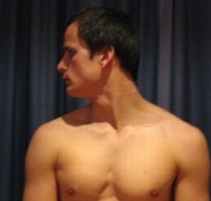


·         Neck extension – this exercise stretches the scalene muscles and the flexors. Bend the neck backwards to the back and hold for 5 seconds then return the head to it neutral position. Repeat 5 times.


·         Neck flexion – this exercise stretches the cervical extensors and upper trapezius muscles. Bend the neck forward to chest and hold for 5 seconds then return the head to the neutral position. Repeat 5 times. 


·         Chin tucks – this exercise stretches the cervical extensors and strengthens the paraspinal muscles. Try to make a double chin, feeling a stretch behind the neck and hold for 5 seconds. Repeat 5 times, relaxing between efforts. 


·         Neck half-circles – this exercise combines all the neck exercises and improve the Range of Motion (ROM). Roll the head slowly from one ear to the same side shoulder, then the chin to the chest and then the other ear to the other shoulder slowly 5 times in each direction.  


Shoulder (these exercises are done standing up)

·         Pendulum exercises – First do this exercise with 1-lb weight for 1-2 minutes. This exercise loosens the shoulder girdle by putting gentle traction on the upper quadrant. Do this exercise near to a table. Place the hand of your unaffected side on the table and bend your body in a 45º degree angle and relax your affected arm perpendicular to your body, aiming to the floor. Do a pendulum movement with your affected arm.  


·         Shoulder shrugs – elevate shoulders up to ears and then slowly lower, repeating five times. This exercise strengthens and relaxes the upper trapezius muscles and encourages scapular retraction and cervical extension.


·          
Sh Shoulder circles – roll shoulders forward five times then backward five times. This exercise alternately strengthens and stretched the entire shoulder girdle.


·         Elbow pinches – place hands on the waist and move the elbows behind your back attempting to touch the elbows together. Hold for 5 seconds, then relax and repeat 5 times. This stretches the pectoral musculature and strengthens the scapular adductors.


·         Corner stretch – stand in a corner or a doorway and put one hand on each wall or doorframe and then slowly let the upper part of the body lean forward into the corner or doorway. Though standing, the body’s position resembles a push-up and stretches the pectoral muscles while strengthening the scapular muscles. 


·         High swings – as a cool-down exercise, stand with arms to side, swinging both arms forward and backward as a pendulum as high as possible in each direction. Repeat five times. 


·         Side swings – swing arms forward crossing each other at shoulder level and then swing the arms back and try to make your shoulder blades to touch. Repeat five times. This loosens the shoulder girdle. 


Crosby, C.A., Marwan, A.W. (2004). Conservative treatment for Thoracic Outlet Syndrome. Hand Clinics (20): 43-49

sábado, 2 de abril de 2011

Thoracic Outlet Syndrome (TOS) - Part I

What is it?

The thoracic outlet syndrome (TOS) is the upper aperture of the chest, between the collar bone and the first rib. It refers to the symptoms that arise when the nerves (three large trunks, forming the brachial plexus) or blood vessels (subclavian vein and artery) that pass through this narrow passageway are compressed at the thoracic outlet.
The thoracic outlet is surrounded by the collar bone at the top and front, the first rib below, and two muscles, one in the front and the other in behind. These muscles, which run downwards from the spine to the first rib, are called the scalene muscles, and their function is to stabilize the first rib. [1]


Causes

TOS is a repetitive motion problem and is commonly occupationally related.  
There are three areas where compression can occur. The first area of compression is the muscle area. Enlargement of the muscles, due to muscle imbalance following a shoulder injury or operation, and repetitive movements that exercise the muscle, such as certain sports, like swimming, ball throwing (cricket), and rugby; musicians, like violinists and flautists; and certain work activities where the arms are elevated a lot, like mechanics, hairdressers, schoolteachers and assembly line workers. Incorrect weight training also can cause a muscle imbalance [2]. Heavy lifting and carrying can bulk up the scalene muscles to the point where the blood vessels and the nerves are entrapped and compressed [3]. Nerve compression can also occur due to the presence of scar tissue between the muscles, for example, a traumatic injury from a car accident. In an accident, the shoulder harness of the car of the seat belt can strain or tear the muscles. As they heal, a scar tissue can build up, thus putting pressure on the nerves and blood vessels at the thoracic outlet [3]. Congenital conditions can also be responsible for TOS, such as the presence of abnormal bands that run over the nerves or between the muscles, or an extra rib in the neck. [2] 


The second area of compression locates between the collar bone and the first rib. Clavicle fractures may predispose to later scar formation, which may compress the structures later on. Fractures of the first rib may also cause immediate damage to the brachial plexus, as it runs over the rib. If there is no immediate damage, symptoms may gradually develop later, like a growth of a scar tissue around the rib. Some people may also have a very thick rib, compressing the the structures against the collar bone [2].
The third area of compression may be further down, below the collar bone, where compression is caused by a thick pectoralis muscle where it attaches to the scapula. [2]
Other causes, such as poor posture and obesity, may aggravate the condition. It occurs classically in women with long necks and dropping shoulders, as well in stocky muscular people. A painful shoulder following trauma or surgery may cause the arm to hang and stretch the nerves over the rib if it is longstanding. [1] The hyperextension-flexion whiplash injury of the neck [4] can cause a muscle spam, which will cause compression nerves and blood vessels, and/or stretching of the brachial plexus.

Symptoms

The symptoms presents on a TOS occur due to the pressure of the blood vessels and nerves. Symptoms of pressure of the subclavian artery consist of coldness, pallor, and fatigue of the arm with exercise. These patients often experience true claudication (muscular cramp sensation). Pressure of the subclavian vein produces swelling, edema and cyanosis (bluish color) of the arm. This happens due to reduced blood flow to the arm and hand (especially in the elevated position). [4]
The symptoms caused by the compression of the nerves are aching pains in the shoulder, neck, arm and hand. There may be a pain shooting all the way down to the fingers, and they may go numb with tingling sensation (paresthesias). Paresthesias most commonly affect the ring and small fingers.. The arm may often go numb, especially when lying on the affected side. 


The hand may feel clumsy and have difficulty with certain tasks, like opening a jar, wringing out a cloth, with tendency to drop things. Overhead activities, carrying objects and driving may also be affected. [1] Headaches may occur, and be severe and disabling, starting at the base of the skull and radiating over the top of the head. [4] 
The severity of the symptoms tends to increase after certain activities, and they are worse at the end of the day or during sleep. [2]

[1] Harris, D., G. Thoracic Outlet Syndrome (T.O.S). Joe de Beer & Associate: Orthopaedic Shoulder Surgion
[2] Franklin, G.M., Glass, L., Javaher, S.P., Kearney, R.N. (2010). Work-Related Neurogenic Thoracic Outlet Syndrome: Diagnosis and Treatment. Medical Treatment Guidelines: Washington State Department of Labor and Industries.
[3] Thoracic Outlet Syndrome. Physical Therapy in Onley and Cape Charles Virginia for Shoulder.
[4] Brantigan, C.,O., Roos, D.,B. (2004). Diagnosing thoracic outlet syndrome. Hand Clin (20): 27-36  

Thoracic Outlet Syndrome (TOS) - Part II

Physical Examination´

TOS is often diagnosed after excluding other conditions that may be present with similar symptoms, such as musculoskeletal injuries of the cervical spine, shoulder girdle or arm, cervical radiculopathy or upper nerve entrapment, idiopathic inflammation of the brachial plexus (aka Parsonage-Turner syndrome), and brachial plexus compression due to an infiltrative process or space-occupying mass (e.g. Pancoast tumor of the lung apex) [2]. An ulnar nerve entrapment at the elbow or a carpal tunnel entrapment at the wrist, can also cause the TOS symptoms. [1]
However there are some provocative tests that can help diagnose the TOS.

Posture

People suffering from TOS often slouch their shoulders, giving them a drooped appearance. The slouching can compress the nerves and arteries near the thoracic outlet. Being overweight can cause problems with posture, and women who have very large breast may also have a droopy posture. TOS affects three times more women than men [3].  

Palpation

Palpation of the brachial plexus, the scalene muscles, the trapezius muscles, or the anterior chest wall may reveal tenderness. [2]

Tests

The tests that can make a clearer diagnose of a TOS include the EAST or Roos test, the Adson test, the Wright test and the costoclavicular test. [2]
In the EAST or Roos test the patient places both shoulders in a 90 degrees abduction and external rotation, and then opens and closes the hands slowly for three minutes. This will constrict the costoclavicular space. The test is positive if the symptoms are reproduced and the patient cannot sustain this test the whole tree minutes. [2] 
In the Adson test the patient extends the neck and rotates the head towards the involved extremity, which is held at the side. This will constrict the interscalene triangle. The patient is asked to take a deep breath and hold it while the physical therapist checks the patient’s radial pulse. The test is considered positive if a change in a radial pulse is detected. [2]
The Wright test is similar to the EAST or Roots test, but the patient is not asked to open and close both hands. Instead, the radial pulse is checked. Once again, if the physical therapist detects any changes in the radial pulse, or if the symptoms are reproduced, the test is positive.
In the costoclavicular test or Eden's test, the physical therapist depresses the patient’s shoulder, which will constrict the costoclavicular space and creates tension across the pectoralis minor. The test is positive if the symptoms are elicited. [2]


Treatment

Stress avoidance, work simplification and job site modification are recommended to avoid sustained muscle contracture and repetitive or overhead work that worsens the symptoms.
Physical therapy, through a passive mobilization of the neck, of the cervical spine vertebras, of the collar bone and of the first rib, will reduce the muscle tension and the pressure of the collar bone and the first rib. Stretching of the scalene muscles will also help to lower the pressure on the blood vessels and the nerves.
Postural exercises can also be done to help you sit and stand straighter, which lessens the pressure on the blood vessels and on the nerves. If you are overweight, losing some weight can be helpful. [1]
If the condition settles, remember that a return to the precipitating factors can cause a recurrence. Avoid carrying heavy bags over the shoulder (TOS is often called “backpackers shoulder”, as heavy weight pushes the collar bone down onto to the first rib, narrowing the TOS). [1]
A study with 50 patients has shown that strengthening and stretching reduced the pain in 80% of the patients after three months and in 94% of the patients after six months. Other studies demonstrated that physical therapy treatment appears to be effective in reducing symptoms, improving function, and facilitating return to work [2].         

[1] Harris, D., G. Thoracic Outlet Syndrome (T.O.S). Joe de Beer & Associate: Orthopaedic Shoulder Surgion
[2] Franklin, G.M., Glass, L., Javaher, S.P., Kearney, R.N. (2010). Work-Related Neurogenic Thoracic Outlet Syndrome: Diagnosis and Treatment. Medical Treatment Guidelines: Washington State Department of Labor and Industries.
[3] Thoracic Outlet Syndrome. Physical Therapy in Onley and Cape Charles Virginia for Shoulder.